Sora Series


 Aquasense X-serien

 Aquasense® 2 Serie


 Skimmer Series

 Tilbehør


A robotic pool cleaner that loses suction power or leaves debris behind is a common issue, but it is rarely caused by a real breakdown. In most cases, the cause is a saturated filter, an incorrect setting, or a type of debris the unit is not designed to handle. Before contacting after-sales support or replacing your robot, a few simple checks are often enough to restore normal cleaning performance.

Saturated filter: the main cause of weak suction
Loss of suction in a robotic pool cleaner is most often caused by a saturated filter that blocks water flow. When the filter basket is filled with leaves, insects, or sediment, the flow rate drops and suction power mechanically decreases, even if the motor is running at full power. The problem is even more noticeable on models with small baskets of 2 to 3 litres, which fill up quickly at the beginning of the season when dead leaves and pollen accumulate in the pool.
Rinse the filter after every cleaning cycle, especially in autumn and spring. Also check that the lid seal is clean and properly positioned. A poorly closed lid creates a water leak that reduces suction power without being visible from the outside. Another possible cause is a sealing issue around the basket itself, which should be inspected if the lid seal is in good condition.

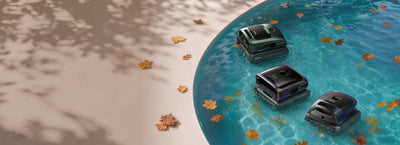
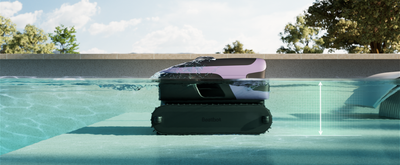
Robots with a large-capacity basket are much less affected. The Beatbot Sora 70 robotic pool cleaner has a 6-litre basket that helps maintain stable suction flow until the end of the cycle, even during periods with heavy debris. The Beatbot Sora 30 offers a 5-litre basket, also well above the market average.
Debris too fine: when the standard filter is not enough
A standard mesh filter of 200 to 300 microns captures leaves, small twigs, and insects well, but it lets sand, pollen, cement dust, or dead algae pass through. The pool floor remains cloudy or slightly gritty despite the robot’s pass. This is a filtration fineness issue, not a suction problem.
Ultra-fine 3-micron filters retain these microscopic particles and visibly improve water clarity from the first pass. The Beatbot Sora 70 and Beatbot Sora 30 offer 150-micron filtration as standard, with an optional 3-micron ultra-fine filter. This dual-filter system makes it possible to switch between large-debris cleaning and fine water polishing depending on pool conditions.
Incomplete cleaning: when the issue comes from navigation
If your robot consistently leaves certain areas dirty, the issue is related to navigation, not suction. Submerged platforms, steps, and shallow areas are especially difficult for robots that do not detect depth changes.

The Beatbot Sora 70 integrates SonicSense™ ultrasonic sensors that detect obstacles and calculate platform heights, allowing it to clean shallow areas and complex pool layouts without getting stuck. The Beatbot Sora 30 can also clean accessible platforms from a water depth of 20 cm.
Leaves and surface debris: why the robot does not collect them
Most robotic pool cleaners clean the floor, walls, and waterline, but they do not collect floating debris such as leaves, insects, or pollen. If your pool still accumulates debris on the surface after the robot has run, this is a model limitation, not a malfunction.
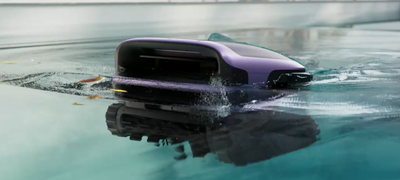
The Beatbot Sora 70 is one of the few robots in its category to integrate water surface cleaning with JetPulse™ technology: two side water jets create four coordinated flows that redirect floating debris towards the suction inlet, preventing debris from bypassing the robot as it moves. The Beatbot Sora 30 does not offer water surface cleaning, but it effectively covers the floor, walls, and waterline.
The robot stops before the end of the cycle: battery or blockage?
If your robot stops its cycle before finishing, two causes should be checked. The first is a battery that is not sufficient for the size of the pool. The second is a mechanical blockage: the robot gets stuck on an obstacle such as a drain, ladder, or step, and consumes battery without moving forward.

The Beatbot Sora 70 and Beatbot Sora 30 each have a 10,000 mAh battery offering up to 5 hours of floor cleaning, enough to cover pools up to 300 m² in a single cycle. Both models can be controlled through the Beatbot app, which displays battery level and cycle status in real time. At the end of the cycle, both robots automatically rise to the surface for easy retrieval, and the SmartDrain™ system on the Beatbot Sora 70 releases internal water to make the unit lighter before lifting it out.
Quick checks before contacting after-sales support
Remove the filter basket and rinse it under running water. If the mesh is clogged with fine particles, soak it for one hour in warm water before rinsing. Check that the filter compartment lid is properly locked and that the sealing gasket is clean and in good condition.
Inspect the brushes: worn brushes or brushes blocked by hair or fibres can no longer loosen debris from the floor, which creates the impression of weak suction even when the pump is working normally. Also check the suction inlet for trapped debris, such as small twigs or stones, that may reduce water flow.

If everything is in order and the problem persists, run a test cycle with an empty filter in a clean pool. Normal suction under these conditions means the issue is linked to the debris load or particle type. In that case, switching to an ultra-fine filter or choosing a larger-capacity model such as the Beatbot Sora 70 or Beatbot Sora 30 can solve the problem over the long term.
FAQs
Why does my robotic pool cleaner stay only in the deep end?
The robot probably does not detect depth changes and avoids slopes it cannot handle. Models without depth sensors remain in the area where they find a flat and stable surface. A robot equipped with ultrasonic sensors, such as the Beatbot Sora 70, adapts its path to floor variations and reaches platforms.
What does brown dust on the pool floor mean?
It is usually soil, dead algae, or oxidised iron deposits from fill water. These particles are too fine for a standard filter. A 3-micron ultra-fine filter captures them and clears the water in one to two passes.
How often should a robotic pool cleaner filter be replaced?
A standard filter in good condition generally lasts one to two seasons. Replace it as soon as the mesh shows holes or deformation, or if suction flow remains weak despite a thorough rinse. Ultra-fine 3-micron filters wear faster and should be checked more often.
Should I leave my robot in the pool permanently?
No. Prolonged immersion accelerates seal wear, degrades the battery, and encourages scale build-up on the filter. Remove the robot after each cycle, rinse the basket, and store it away from direct sunlight. This habit helps preserve suction power over the long term.