Sora Series


 Série Aquasense X

 Série Aquasense® 2


 Skimmer Series

 Accessoires


The best robotic pool cleaner for leaves is one that can collect whole leaves without clogging, clean both the water surface and the pool floor, and provide enough cleaning time for a family pool.
Across Europe, where trees such as plane trees, oak trees, lime trees and olive trees produce different amounts of fallen leaves depending on the region, choosing the right model mainly depends on two technical factors: the diameter of the suction inlet and the capacity of the filter basket.
The Beatbot Sora 70 and Beatbot Sora 30 both address this need, but they are designed for different types of pools and levels of leaf exposure.
What makes a pool robot effective against leaves?
An effective pool robot for leaves depends on four key factors: the width of the suction inlet, the capacity of the filter basket, suction power measured in GPH, and whether the robot can clean the water surface.
Many pool robots appear powerful but have suction openings that are too narrow to collect whole leaves. This can cause blockages and force the robot to make repeated passes over the same area.
A wet plane tree or oak leaf can often measure between 10 and 15 cm. If the robot opening is smaller, the leaf can become stuck in front of the inlet and reduce suction performance.
In terms of filtration, a 2 to 3 litre basket can fill during a single cleaning session during autumn leaf fall, requiring the user to stop the cycle and empty it.
Leaves can remain floating on the water surface for several hours before sinking. A pool robot that only cleans the floor leaves this stage to the skimmer, which can quickly become overloaded.
A robotic pool cleaner with surface cleaning removes floating leaves before they reach the bottom, reducing pressure on the filtration system.
For large amounts of leaves already collected on the pool floor, a pool leaf net or manual vacuum cleaner can still be useful before starting the robot. This prevents a thick layer of leaves from filling the basket at the beginning of the cleaning cycle.

Cordless, electric or hydraulic pool robot: which type is best for leaves?
Hydraulic pool cleaners and corded electric pool robots are still available, but each type has limitations when dealing with large amounts of leaves.
Today, cordless electric pool robots are becoming a preferred choice because they combine strong suction power, a large integrated filter basket and complete freedom of movement throughout the pool.
Hydraulic pressure or suction pool cleaner
A hydraulic pool cleaner connects to the skimmer or a booster pump. It does not have its own filter and sends debris towards the pump pre-filter or sand filter.
When dealing with leaves, this creates two problems: the pre-filter becomes full quickly and requires manual emptying, while the sand filter can become clogged and require more frequent backwashing.
This type of cleaner is suitable for pools with limited leaf exposure, but not for pools surrounded by trees.
Corded electric pool robot
A corded electric pool robot has its own filter basket, independent from the pool filtration system.
It collects leaves and debris directly into its own basket, preventing the skimmer from becoming overloaded.
The main limitation is the cable: it can become tangled in long or free-form pools and requires access to a nearby power socket.
Cordless electric pool robot
A cordless pool robot includes its own filter basket and moves freely around the pool, allowing complete coverage even in free-form pools or overflow pools.
Its main limitations are cleaning time per charge and battery lifespan, making lithium-ion battery quality an important factor.
The Beatbot Sora 70 and Sora 30 feature a 10,000 mAh battery, which is above the average range of this segment, usually between 5,000 and 7,000 mAh.
Beatbot Sora 70: for pools with heavy leaf exposure
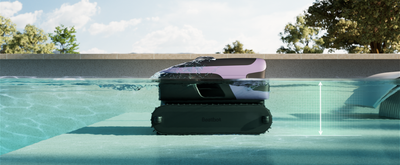
The Beatbot Sora 70 is a cordless pool robot that combines an extra-large suction inlet, a 6-litre filter basket and active water surface cleaning.
This configuration allows it to handle a complete autumn leaf season without requiring the user to interrupt the cleaning cycle to empty the basket.
Suction inlet designed to collect whole leaves
The Beatbot Sora 70 features a 6.7-inch suction inlet, approximately 17 cm, combined with a suction power of 6,800 GPH.
This wide opening can collect whole leaves from plane trees, oak trees and chestnut trees without requiring pre-cutting.
The dual brushes create a 10-inch cleaning path, reducing the number of passes required during the cleaning cycle.
6-litre filter basket for a complete leaf season
The filter capacity is 6 litres, which is two to three times larger than the average capacity of many models on the market.
During the leaf-fall season, users no longer need to open the basket halfway through the cleaning cycle to empty it.
The standard 150-micron filter captures leaves, small branches and insects.
An optional 3-micron ultra-fine filter is available for pollen, dead algae and finer debris.
Surface cleaning with JetPulse technology
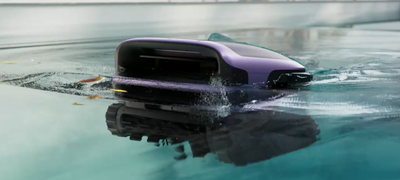
The Beatbot Sora 70 uses JetPulse technology with two side jets that direct water both inwards and outwards, creating four coordinated water flows in total.
The converging flows move floating leaves towards the central suction inlet.
The diverging flows prevent leaves from passing around the sides of the robot.
As a result, leaves are removed before they sink to the bottom of the pool, reducing pressure on the pump pre-filter and the skimmer.
Runtime, coverage and warranty
With its 10,000 mAh battery, the Beatbot Sora 70 provides:
- up to 5 hours of floor cleaning
- up to 4.5 hours of combined floor, wall and waterline cleaning
- up to 7 hours of surface cleaning
It covers up to 300 m², making it suitable for rectangular family pools, free-form pools and overflow pools.
The robot weighs 10.4 kg out of the water.
The intelligent parking system returns the robot to the pool edge when the cleaning cycle is complete.
The manufacturer warranty is 3 years.

Beatbot Sora 30: for pools with moderate leaf exposure
The Beatbot Sora 30 is a cordless pool robot that keeps the same 6,800 GPH suction power and a 5-litre filter basket, but without the surface cleaning function.
For a pool without large trees directly nearby, this configuration is sufficient in most cases.
Floor, wall and waterline coverage
The Beatbot Sora 30 cleans the floor, walls and waterline in a single cycle.
It actively detects platforms and shallow areas from a depth of 20 cm, which is useful for pools with underwater benches or steps where leaves often collect in corners.
If your pool receives many leaves that float before sinking, surface cleaning remains managed by the skimmer.
5-litre basket and 150-micron filtration
The 5-litre basket with a 150-micron filter can collect more than 650 leaves in one session according to Beatbot.
For a family pool, this corresponds to several weeks of autumn use without needing to empty the basket during the cycle.
An optional 3-micron ultra-fine filter for periods with high pollen levels is available from Beatbot and sold separately.
Runtime, parking and warranty
With its 10,000 mAh battery, the Beatbot Sora 30 provides:
- up to 5 hours of floor cleaning
- up to 4.5 hours of combined floor, wall and waterline cleaning
- coverage of up to 300 m² per charge
The surface parking system returns the robot to the pool edge when the cleaning cycle is complete.
The manufacturer warranty is 2 years.
Sora 70 or Sora 30: which pool robot should you choose based on your environment?
The choice between the Beatbot Sora 70 and the Beatbot Sora 30 depends on two factors: the amount of leaves that fall directly into your pool and how long those leaves remain floating on the water surface before sinking.
The Beatbot Sora 70 is designed for pools surrounded by trees, where large amounts of leaves need to be handled. The Beatbot Sora 30 is better suited for pools with lower leaf exposure that still receive leaves seasonally.
|
Criteria |
Beatbot Sora 70 |
Beatbot Sora 30 |
|
Surface cleaning |
Yes, JetPulse technology |
No |
|
Cleaning areas |
Floor, walls, waterline and surface |
Floor, walls and waterline |
|
Suction power |
6,800 GPH |
6,800 GPH |
|
Filter basket capacity |
6 L |
5 L |
|
Floor cleaning runtime |
Up to 5 hours |
Up to 5 hours |
|
Maximum coverage |
300 m² |
300 m² |
|
Warranty |
3 years |
2 years |
When is the Sora 70 the right choice?
Choose the Beatbot Sora 70 if your pool receives leaves for several months of the year, especially during autumn and spring when leaves and flowers fall into the water.
The Sora 70 is particularly suitable if:
- your pool has a large surface area
- your pool is surrounded by trees
- your skimmer becomes overloaded with leaves regularly
- you own an overflow pool where keeping the water surface clean is important
The Sora 70 belongs to the premium range and has a higher purchase price, which is balanced by its surface cleaning function, larger filter basket and three-year warranty.
When is the Sora 30 enough?
The Beatbot Sora 30 is sufficient if your pool mainly receives smaller debris, if trees are located further away, or if the pool is covered for most of the year with a pool cover or automatic cover.
It is also suitable for pools located under pergolas or low pool enclosures, where the water surface is less exposed to wind-blown leaves.
The Sora 30 is positioned in the upper mid-range category, offering a lower price than the Sora 70 while maintaining the same suction power and 10,000 mAh battery.

Key factors to check before buying a pool robot for leaves
Choosing the right pool robot also depends on your actual pool configuration and the expected lifespan of the device.
The following factors determine whether a model will perform reliably over multiple seasons.
Pool type and material
Both Beatbot models clean both in-ground and above-ground pools with different surfaces:
- pool liner
- tiles
- concrete
- polyester pool shells
- fibreglass
On rougher surfaces, such as textured liners or unfinished sprayed concrete, brush wear can occur faster.
With intensive use, brushes should be replaced approximately every 18 to 24 months, while on smooth surfaces such as tiles or smooth pool shells, they can last around 3 to 4 years.
Replacement brushes are available as spare parts.
Pools with flat bottoms generally allow better cleaning coverage than pools with complex floor designs, where changes in slope can slow the robot's movement.
Minimum depth and shallow areas
The Beatbot Sora 70 and Beatbot Sora 30 can clean platforms and shallow areas from a minimum depth of 20 cm.
The Sora 30 also requires a minimum platform size of approximately 1 metre by 1 metre. Below this size, it avoids entering to reduce the risk of getting stuck.
Underwater benches, beach areas and wide steps can be cleaned as long as they meet this requirement.
Pool shape
Free-form pools and pools with rounded corners require a pool robot with effective adaptive navigation.
Both models use ultrasonic sensors to adjust their routes. However, the Beatbot Sora 70 also includes a front sensor and a lower sensor that improve the detection of obstacles, platforms and changes in slope.
For narrow swimming lanes or overflow pools with a visible balance tank, the Sora 70 is the recommended choice.
Recovery and weight
Both models feature automatic surface parking and the SmartDrain system, which removes internal water before the robot is taken out of the pool.
The Beatbot Sora 30 weighs 8.9 kg out of the water once the drainage system has been activated, making it manageable for most users.
Battery reliability and lifespan
A high-quality lithium-ion battery can support 500 to 800 full charging cycles before losing a significant amount of capacity.
With one cleaning cycle every two to three days during the swimming season, this corresponds to approximately five to eight years of use.
The Beatbot Sora 70 and Sora 30 both include a 10,000 mAh battery, which is above the average capacity of this product category.
Even after a 30% loss of capacity, the remaining runtime remains close to that of many new competing pool robots.
Leaf challenges for European pools
Across Europe, the type and amount of leaves entering a pool vary significantly depending on the region and the surrounding garden environment.
Trees such as plane trees, oak trees, lime trees, olive trees and pine trees can create different types of debris throughout the year.
Plane tree and oak leaves are often large and durable, remaining on the water surface for a long time before sinking. During autumn, strong winds can bring large quantities of leaves into a pool overnight.
Olive trees produce small, tough leaves throughout the year, which can accumulate in pump pre-filters.
Mediterranean pine trees can also drop needles, which require suitable filtration to prevent accumulation.
In central and northern European regions, trees such as oak, lime and chestnut produce softer leaves that sink faster but can decompose more quickly and affect water quality if they remain on the pool floor for several days.
Pools located near birch trees or other high-pollen trees can also benefit from an ultra-fine filter during spring.
During peak leaf-fall periods, a daily or every-other-day cleaning cycle helps prevent a thick layer of debris from covering the pool floor, which would become much harder to remove later.
Both Beatbot Sora models can be programmed through the Beatbot app, with cleaning mode selection and cleaning history tracking.

FAQs
Can a pool robot completely replace the skimmer?
A pool robot with surface cleaning significantly reduces the workload of the skimmer, but it does not completely replace it.
The skimmer continues working during periods when the robot is not running and collects debris that enters the pool between cleaning sessions due to wind or other factors.
Both systems remain complementary for maintaining a clean pool.
Why is my pool robot not picking up leaves?
There are three main reasons:
- The suction inlet is smaller than the size of the leaves, causing them to remain stuck in front of the opening instead of being collected.
- The filter basket is full and suction performance decreases.
- The brushes are worn and can no longer effectively collect leaves attached to the pool floor.
How much does a good pool robot for leaves cost?
Effective pool robots for leaves can generally be divided into three price categories.
Corded models usually cost under €500, but often have smaller suction openings and more limited filter capacity.
Cordless pool robots are generally priced between €500 and €1,500, offering a good balance between suction power, runtime and convenience.
Cordless models with surface cleaning usually cost more than €2,000, but they can significantly reduce maintenance time during the leaf season.
How long does a cordless pool robot battery last?
A high-quality lithium-ion battery can support several hundred complete charging cycles.
With one cleaning cycle every two or three days during the swimming season, this can provide several years of service before battery capacity noticeably decreases.
Modern cordless pool robots typically use batteries between 7,000 and 10,000 mAh, which directly affects the available runtime throughout the product lifespan.